How Far Into the Past Can We See?
The oldest light in the sky shows us a time before the first stars. Sagan's cosmic calendar shows how far back that is.
The oldest light in the sky shows us a time before the first stars.
Imagine it is New Year’s Eve, with twelve seconds left before midnight. If the whole history of the universe were squeezed into one year, people would only now be starting to write things down. Everything we have ever recorded, from marks in clay to the words on this screen, would fit into those last seconds.
Carl Sagan used this picture in Cosmos and called it the cosmic calendar. The universe is about 13.8 billion years old. Spread over 365 days, our 5,200 years of writing take up about twelve seconds, and even the first humans like us appear only a quarter of an hour before midnight.
That raises a question. How can we see what the universe looked like before anyone was here to look at it? The answer starts with light.
Looking up means looking back
Light takes time to travel. The delay is far too small to notice when we switch on a lamp, but in space the distances are enormous. Light from the Moon needs about 1.3 seconds to reach us, so we see the Moon as it was 1.3 seconds ago.
The same holds for stars. The nearest star beyond the Sun is more than four light-years away, and a light-year is the distance light covers in one year. We see that star as it was more than four years ago, because its light has been travelling all that time. For distant galaxies, the journey takes billions of years. NASA’s guide to how Webb sees back in time uses the same examples, from the Moon to the most distant galaxies. A telescope stays firmly in the present. It collects old light that is only now arriving.
A distant galaxy may have changed a lot while its light was on the way. It may even have merged with another galaxy. We see its earlier life. The sky is therefore a mix of many moments: each object appears at a different point in its own past, and the farther away it is, the older the light.
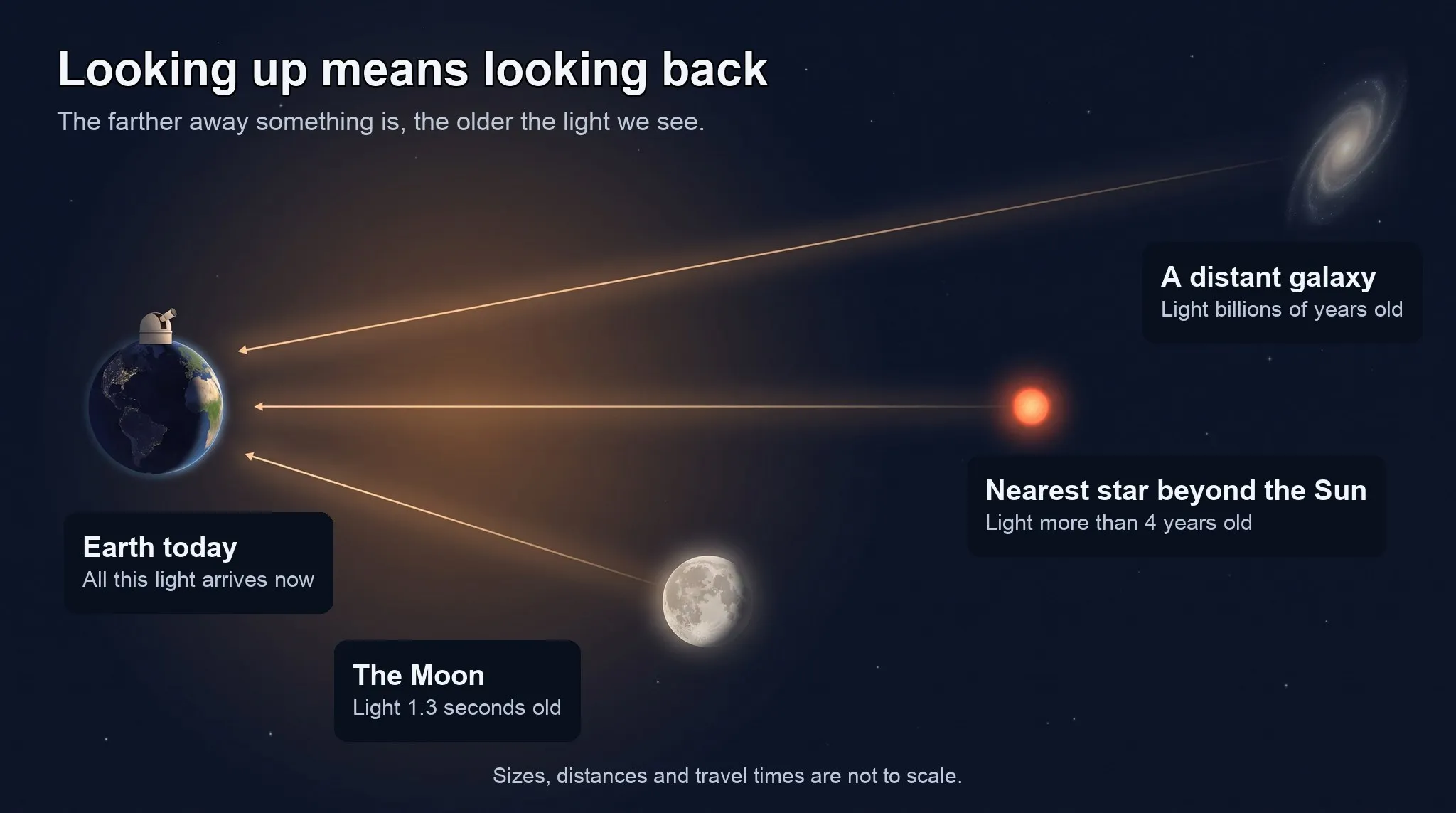
Three beams arrive at the same moment, but they left at very different times. Sizes, distances and travel times are not to scale. Illustration with typeset labels; the idea follows NASA’s explanation of light travel time.
Can we see all the way back?
If older light comes from farther away, a bigger telescope should show us the Big Bang itself. Look farther, find older light, and keep going. But every telescope meets the same wall: the early universe was opaque to light.
Before there were stars, the universe was hot and dense. Electrons and atomic nuclei moved around separately. Light is a wave of electric and magnetic fields, and electric charges respond to it. Free electrons weigh very little and respond strongly, so they scattered light in every direction; the much heavier nuclei barely affected it. A ray of light travelled only a short way before an electron sent it somewhere else.
Think of a building behind thick fog. You know it is there, but its light reaches you scattered and blurred. The fog of the early universe was made of free electrons instead of water droplets, and it had the same effect: light was scattered before it could arrive.
When the fog cleared
As the universe expanded, it cooled. About 380,000 years after the Big Bang, electrons could stay bound to nuclei, and neutral atoms formed. The electrons were still there, but as parts of atoms they responded to light differently and let most of it pass. Matter had changed how it interacted with light, and light could now travel much farther.
NASA’s Cosmic History article describes this moment. Light already existed before this moment; this was the point when it could begin a long, mostly clear journey. The first stars came later.
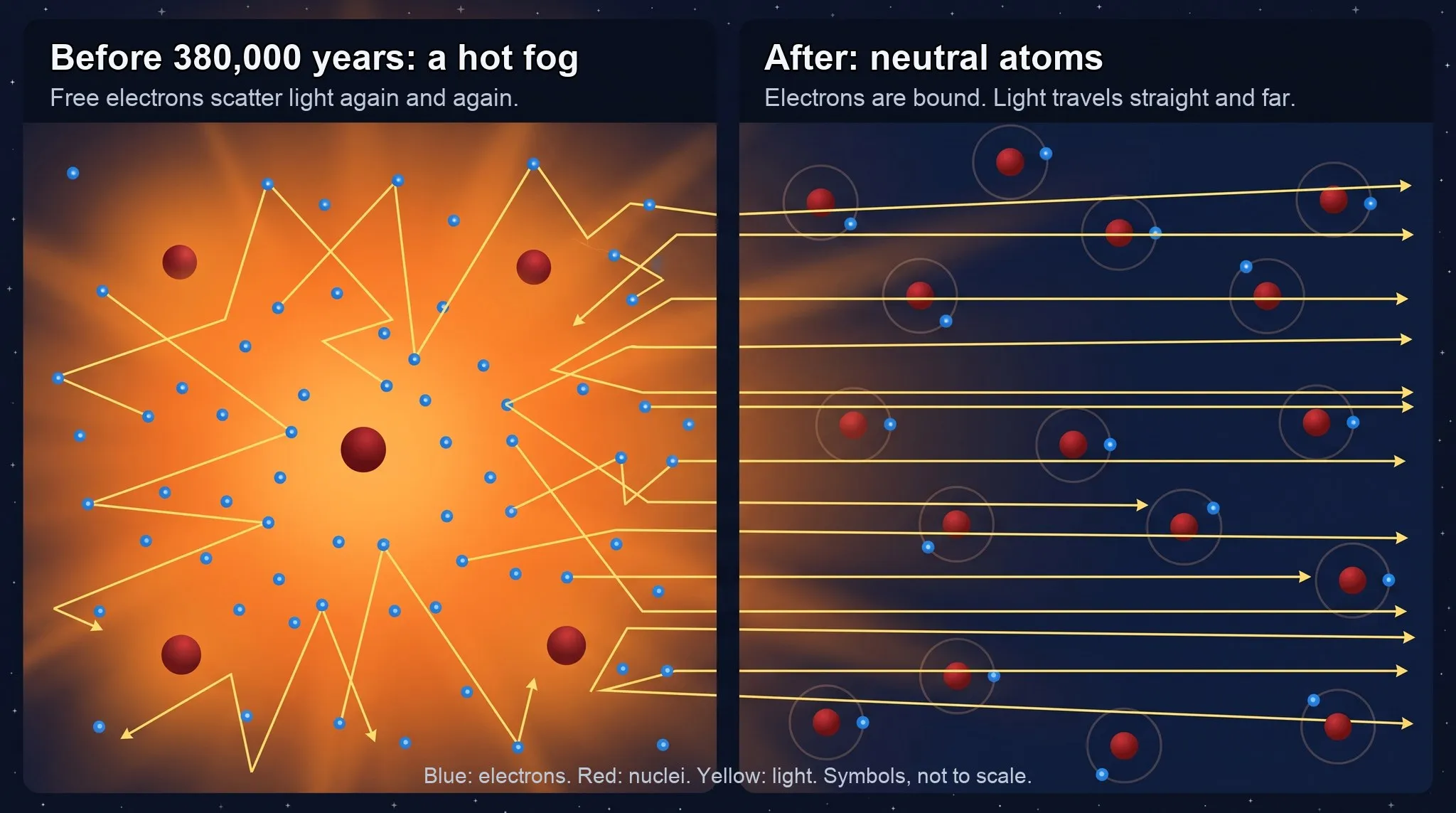
Before 380,000 years, free electrons scatter light again and again. After neutral atoms form, light travels straight and far. Blue dots are electrons, red spheres are nuclei, yellow lines are light; these are symbols, not to scale. Background: NASA and a study of scattering during atom formation.
Some of that ancient light is still reaching us. We call it the cosmic microwave background, or CMB. As space expanded, the waves of that light stretched with it, and today we detect them as microwaves. Our eyes miss them, but microwave instruments pick them up. ESA’s Planck guide explains how this happened.
What does the old light show us?
The CMB comes from every direction, because that light was released everywhere in the universe at about the same time. Space missions such as WMAP and Planck have measured it across the whole sky, and the result is a map like this one.
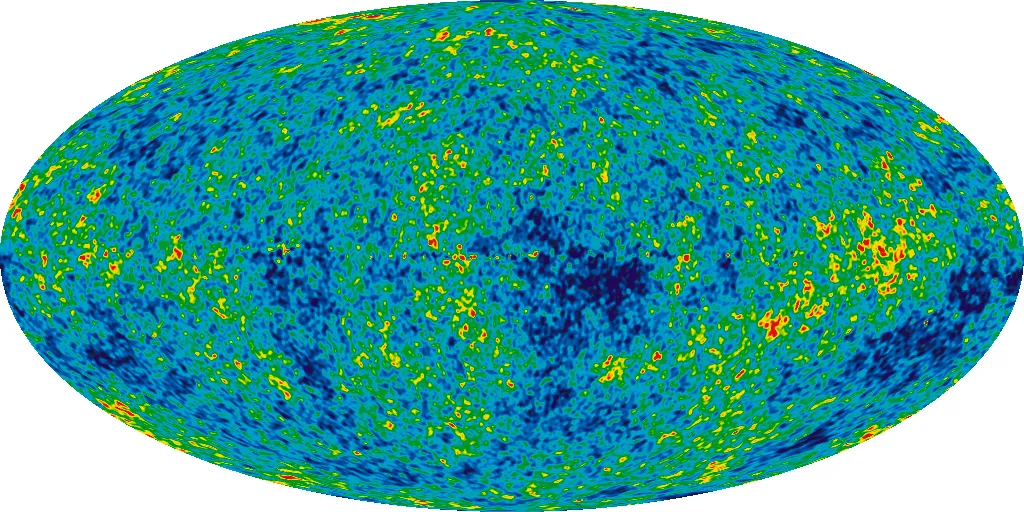
Nine years of WMAP measurements. The colors stand for tiny temperature differences, and the oval is a way to draw the whole sky on a flat page. Credit: NASA/WMAP Science Team. Source.
The colored patches are small differences in the old radiation, and they tell scientists how matter was spread out in the early universe and how it later gathered into galaxies.
People sometimes call this a baby picture of the universe. That is a good comparison, as long as we remember the age in the picture: the universe was already about 380,000 years old. The Big Bang itself stays hidden behind the fog.
The first minutes of the year
Now return to Sagan’s calendar. Our written history fills the last twelve seconds of December 31. The light we see in the CMB set out about fourteen minutes after midnight on January 1.
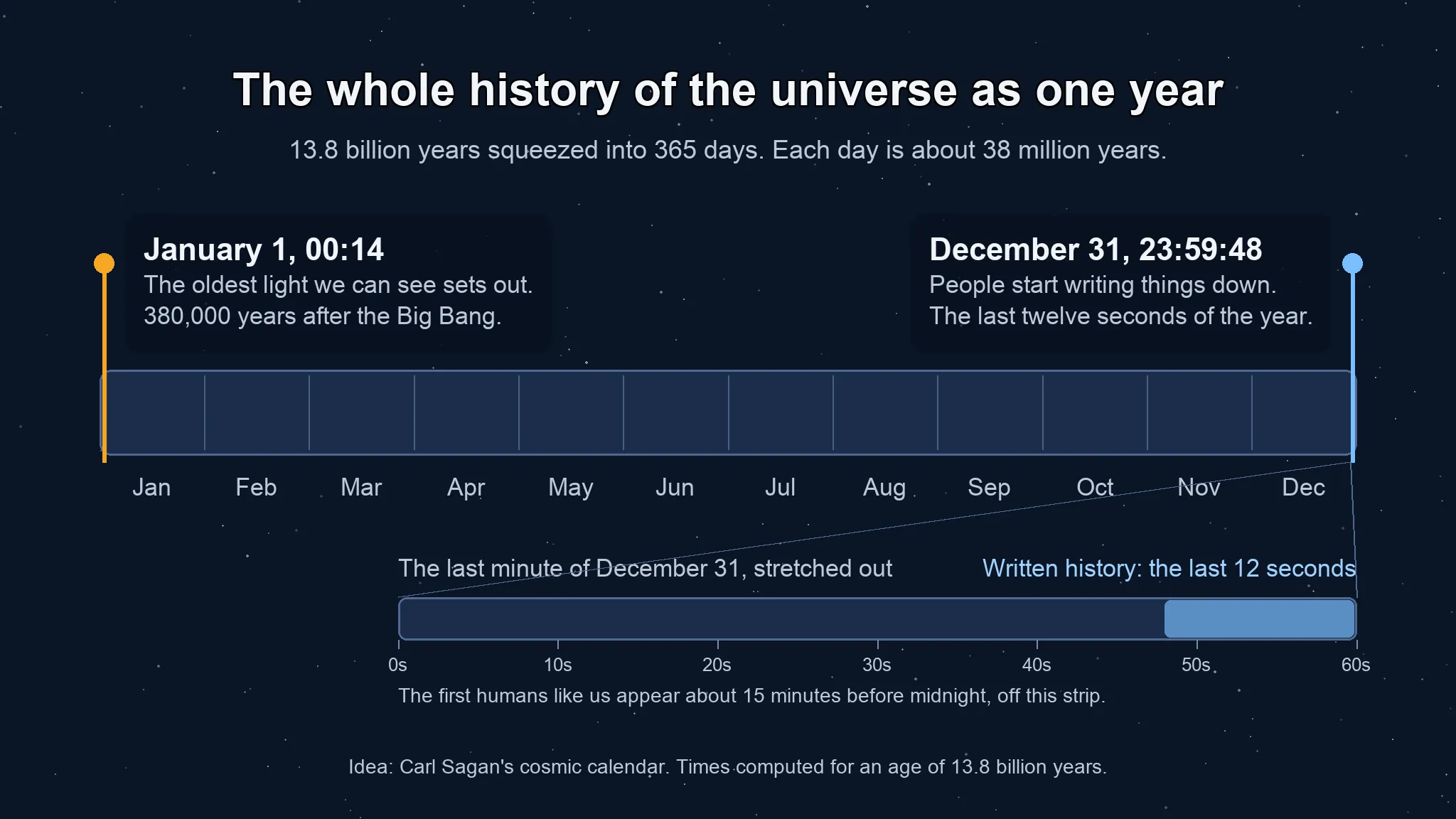
The whole history of the universe as one year. The oldest light we can see sets out fourteen minutes into January 1; writing begins twelve seconds before the year ends. Times computed for an age of 13.8 billion years.
Our records begin at the very end of the year, yet the oldest light we can observe lets us look back to its first minutes. That is more than another way of saying the universe is old. It shows how far beyond our own history we can see.
The CMB is the oldest light we can use this way. Scientists still study earlier times through other clues, and they test those ideas against measurements. But working out what probably happened is a different thing from receiving light from that time.
Light from the young universe is arriving right now. It set out before Earth, before the Sun and before the first stars, and our instruments are catching it today.
Resources
- NASA: Cosmic History: the early universe, neutral atoms and the CMB.
- NASA: How Does Webb See Back in Time?: light travel time, from the Moon to distant galaxies.
- ESA: Planck and the Cosmic Microwave Background: how the CMB is measured and why it arrives as microwaves.
- StarTalk: Big Bang Bonanza with Brian Keating: Neil deGrasse Tyson and Brian Keating on the early universe. Some parts go deeper than this article.
- Astronomical Society of the Pacific: Cosmic Calendar: a classroom activity based on Sagan’s idea. It uses an older age estimate, so its times differ slightly from this article.
- British Museum: How to Write Cuneiform: early writing. Its beginnings were gradual, so the twelve-second figure is approximate.